
The caseTwo extra words on Annie’s text
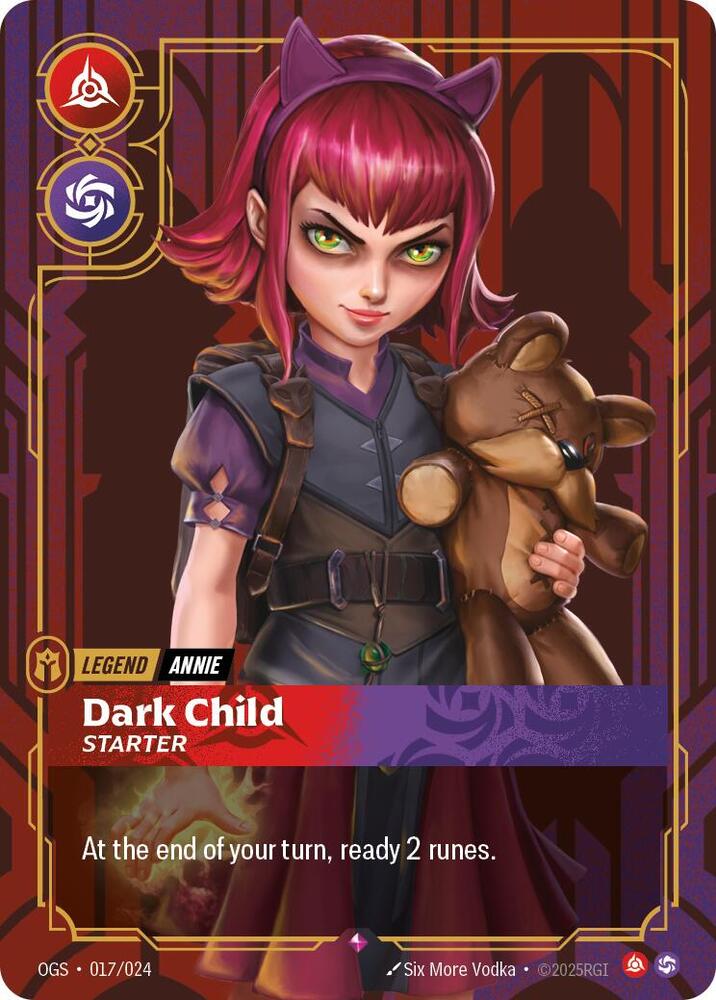
Annie, Dark Child is the legend of the Proving Grounds deck. The printed cardboard says that at the end of your turn you ready 2 runes — stand them back up after exhausting them to pay. The text that actually counts, though, is not the printed one.
| Printed text | At the end of your turn, ready 2 runes. |
|---|---|
| Errata text | At the end of your turn, ready up to 2 runes. |
The errata is not new: Riot published it on October 28, 2025 in the Riftbound: Origins Card Errata document, where the card is listed as “Dark Child, Starter”. It covers the promotional reprints of the same legend too, from the Nexus Night version to the Prize Wall Plated Legend. In that announcement Riot lays out its policy: changing the wording of an already printed card “add[s] friction to your gameplay experience, and we don’t issue them lightly”. An errata clarifies how a card works; it does not make it stronger or weaker — that is what the ban list is for.
The rule“As much as you can” applies later, not earlier
The thread’s confusion comes from rule 056 of the Core Rules Document, the one everybody remembers: when executing card text, do as much as you can and ignore impossible instructions. If that is true, then with a single exhausted rune Annie should just stand that one up and be done with it. The catch is when it applies: that rule governs resolution, the moment the ability leaves the chain and takes effect. Before that, the ability has to go onto the chain, and that is already when you name your targets — the Core Rules are explicit that a rune you control is a target, chosen as you put the ability on the chain, not afterwards. “Ready 2 runes” asked for two of them right there.

On resolution
Execute the text doing as much as you can and skip impossible instructions. This applies when the ability takes effect, not when you choose it.
On the chain
If a triggered ability already on the chain has too few legal choices, it is removed from the chain and does nothing. That is not a counter: it simply goes away.
Put together, the two rules describe what the printed text really did: with a single exhausted rune you could not name two targets, the ability fell off the chain and you did not even ready that one rune. That was the difference between having a rune up on your opponent’s turn and not having one. That is the same explanation u/Chief_Hazza gave in the thread, while u/MASISCH boiled it down to one line: “ready 2” only works if you have two to ready, “up to 2” lets you choose anywhere from zero to two.
The sequelWhy so many new cards say “up to”
The thread raised a second point: recent cards often read “choose up to 2 targets”, which looks redundant. It is not. The Core Rules give “up to” and “any number of” a rule of their own: there you may choose as many targets as you like, zero included, and the card is still played even with no targets at all.
At the table that means “2 targets” is a requirement to be met, while “up to 2 targets” is a ceiling. The first wording can leave you with nothing when the board is bare; the second cannot. Which is why two small words on Annie are not a matter of style.
| Ready | Standing an exhausted card back up so it can be used again. |
|---|---|
| Exhaust | Turning a card sideways to use it or to pay. |
| Chain | The queue where spells and abilities wait before taking effect. |
| Target | What you name as you put the card or ability on the chain, not when it resolves. |
| Triggered ability | An ability that fires on its own when something happens. Here: “at the end of your turn”. |
Why it matters for us. Annie, Dark Child is the legend of Proving Grounds, one of the most widespread entry products in Italy too, and the text most players are holding is the old one. In a tournament the errata is what counts, not the cardboard. And nine days out from the European Regional Championship in Stuttgart, the gap between “I choose targets” and “I resolve the effect” is exactly the kind of question that gets a judge called over.
The short version
- Annie, Dark Child reads “ready up to 2 runes”: that comes from Riot’s official Origins errata of October 28, 2025, not from the printed text.
- “Do as much as you can” applies when the ability resolves; targets are chosen when it goes on the chain.
- With the old text and a single exhausted rune, the ability fell off the chain and readied nothing at all.
- “Up to” is not redundant: it lets you pick zero targets and still play the card.
Sources: Riftbound: Origins Card Errata and the Rules Hub (Riot Games); the thread by u/Jedyctp on r/riftboundtcg. Images: Riot Games.
Spotted an error?
To send a report you must first log in or sign up: it only takes a few seconds.