
Vendetta's new rules: Empower, Flow, Burn and everything that changes on July 24
Alongside the bans, Riot published today the Core Rules patch notes for Vendetta: the rules for the set's four new mechanics — Empower, Flow, Burn and Skip — plus a long list of fixes and clarifications that also touch cards you already play. Everything takes effect on Friday, July 24, 2026, and this time the update lands early: Riot listened to player feedback after Unleashed and wants judges and players to have time to study before the first Pre-Rift events.
The set's mechanicsEmpower: the status that stays
Empower is Vendetta's tentpole mechanic and can touch units, gear and even Legends. Here's how it works: many cards in the set carry the Empower keyword, an activated ability with a cost. Pay the cost and the card becomes empowered — a lasting status that persists until the card leaves the board or gets disempowered.
The key thing to understand: the empowered status does nothing on its own. It's a switch. What exploits it are the Empowered abilities (the «dependent» keyword): while the card is empowered, the extra effect is on. Three practical rules to remember at the table:
- ⚡ You can't activate Empower on a card that's already empowered: no wasted double payments.
- 🔌 Some effects disempower as an instruction or a cost: that simply means removing the status. You can't disempower something that isn't empowered.
- 🚪 If the card leaves the board, the status resets: you'll have to pay the Empower again when it comes back.
The set's mechanicsFlow: spells played from the trash
Flow is the second pillar mechanic, and if you come from other TCGs the comparison is immediate: it's Riftbound's Flashback. The keyword appears on spells and is both a permission and an alternate cost: by paying the Flow cost you can play the spell straight from the trash — after which the card is banished. One and done, no infinite recursion.
A smart design detail: Flow cards have a dedicated symbol in their text box flagging «this card does something from the trash». Riot has already said the symbol will appear on more cards in the future: the trash is no longer a graveyard — it's becoming a second hand.
The set's mechanicsBurn: the deck burns (and it's worth it)
And how do you fill your trash with Flow spells? With Burn, the set's third mechanic. «Burn X» means taking X cards from the top of your Main Deck and putting them in your trash. A mini-economy revolves around burning: some cards trigger when burned, some effects fire when you burn, and others count how many cards you've burned in a turn.
The flip side is stated in the patch notes themselves: burning brings you closer to burning out. Danger and value go hand in hand — you thin your future resources in exchange for immediate fuel. The Burn + Flow synergy is the set's most obvious engine: you burn to fill the trash, then fish spells back out of it with Flow.
The set's mechanicsSkip: skipping part of your turn
For the first time there's a card that lets a player skip part of their turn, and to support it the Skip action is born: a replacement effect that replaces the named event or procedure of the turn with... nothing. The important consequence is in the word «nothing»: anything that would have resulted from that part of the turn doesn't happen — no triggers, no attached procedures.
| Mechanic | Where it appears | What it does |
|---|---|---|
| Empower / Empowered | Units, gear, Legends | Activated ability with a cost: the card becomes «empowered» indefinitely, switching on its Empowered effects |
| Disempower | Instructions and costs | Removes the empowered status |
| Flow | Spells | Alternate cost to play the spell from the trash; it's banished after resolving |
| Burn | Various cards | Sends X cards from the top of the Main Deck to the trash; related triggers and counts |
| Skip | Special effects | Replacement: a part of the turn doesn't happen, along with all its triggers |
Support rulesThe new foundations the set needs
Beyond the keywords, Vendetta introduces effects that needed dedicated rules. The most interesting ones:
- 🗣️ Naming cards, types and tags: there's now a formal procedure for effects that ask you to «name a card» (with some extra flexibility compared to types and tags).
- 🙈 Ignoring effects: a new class of abilities that ignore other abilities, managed through the inactive-text machinery.
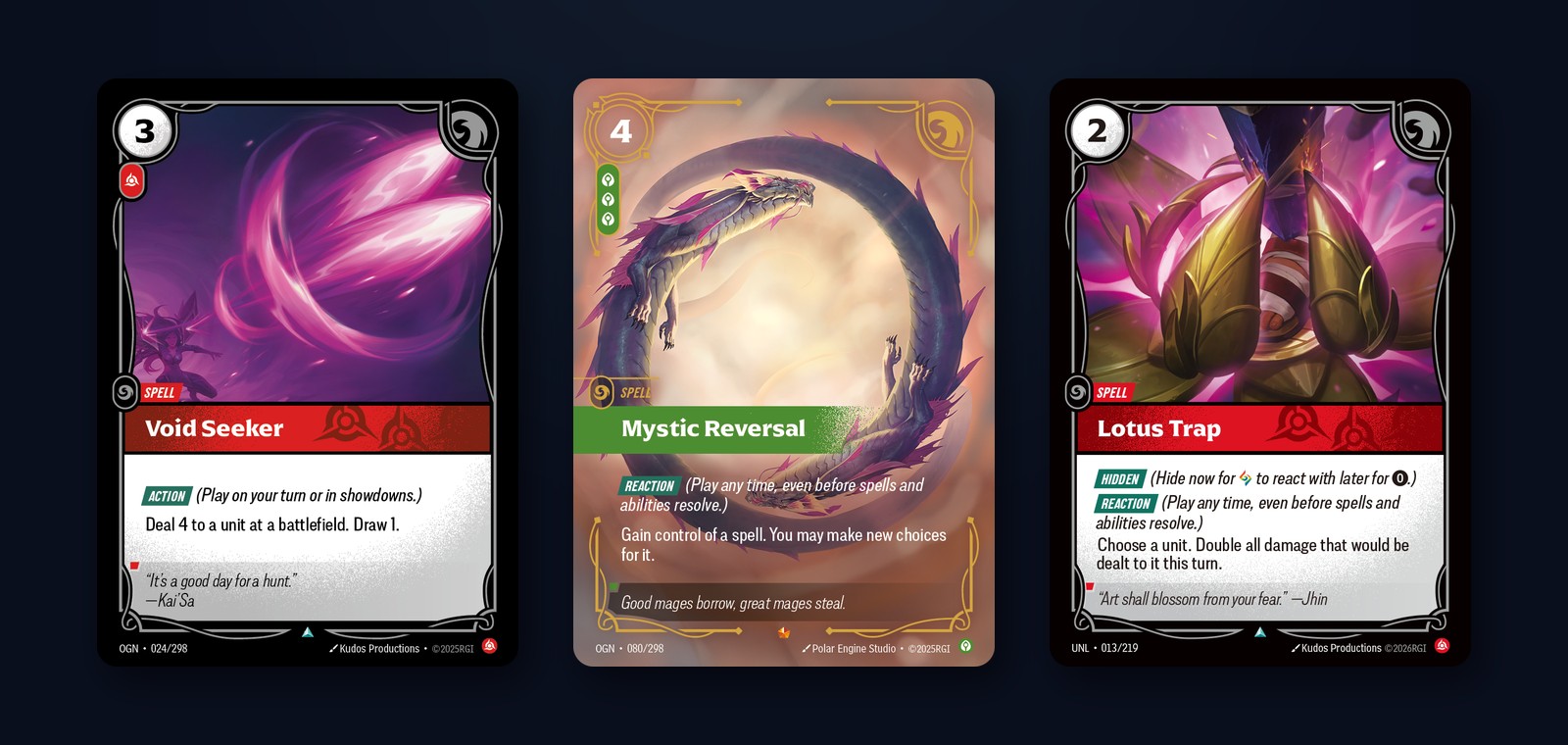
- 🛡️ Untargetable: more cards in the set make units impossible to choose with enemy spells and abilities. If a unit becomes untargetable after being targeted, the spell mistargets on resolution: any instructions related to it are ignored — the same principle as the classic Void Seeker case with the unit returned to base in response.
- 🔁 Making new choices: new rules for Mystic Reversal-style effects that let you remake choices for a spell on the chain (timing, legality, nature of the choices).
- 🃏 Cards with multiple types: the game's first multi-type card arrives, with the rules to manage it.
- 📖 «Use» becomes «play»: from Vendetta onwards, card text says «play» for activating activated abilities too. The Core Rules recognize both words, so older cards remain valid.
- 💥 Replacement effects and combat damage: every replacement effect that would modify damage dealt to units now applies already at combat damage assignment, not just when the damage is dealt. More intuitive, at a price: with damage-increasing effects (like Lotus Trap) the assignment math gets slightly more complex.
The heavy hittersThe changes that matter for competitive play
Here the patch notes stop talking about Vendetta and touch the game everyone already plays. The three changes we think will matter most:

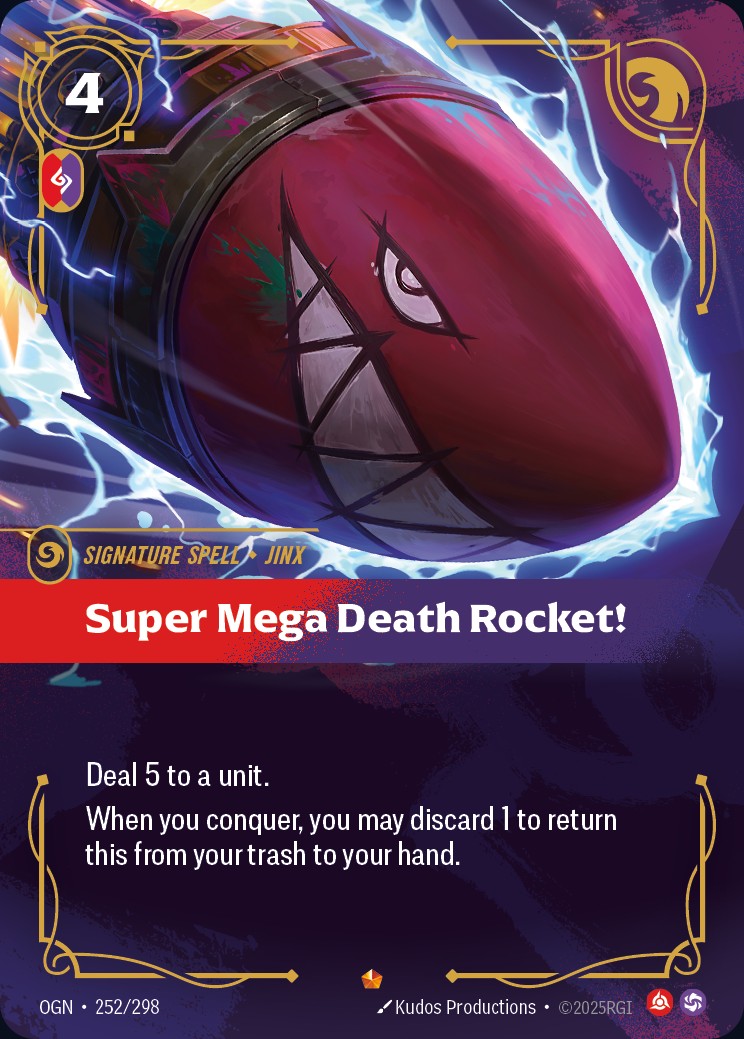
1. Dual-domain cards must be paid with their own domains. We're talking about cards with two domains — domains are Riftbound's «colors»: Fury, Chaos, Mind, Body, Calm and Order, each with its own symbol — meaning the two-color Legends and above all their Signature Spells (the «Signature» supertype: Super Mega Death Rocket!, Icathian Rain and friends — not to be confused with the alt-art collector variants). Until now, by the written rules, their power cost was technically payable with power of any domain. In practice that changed nothing: your deck can only contain your Legend's domains, and the Signature has exactly those domains — so the power in your pool is «the right color» anyway. The fix is about coherence (the cost symbols carry colors, and the written rule now respects that: the power cost must be paid with power of the card's domains, with only an [A] in the text staying open) and above all about future-proofing: if three-domain cards, or effects that put off-color power in your pool, ever arrive, the rule is already in place.
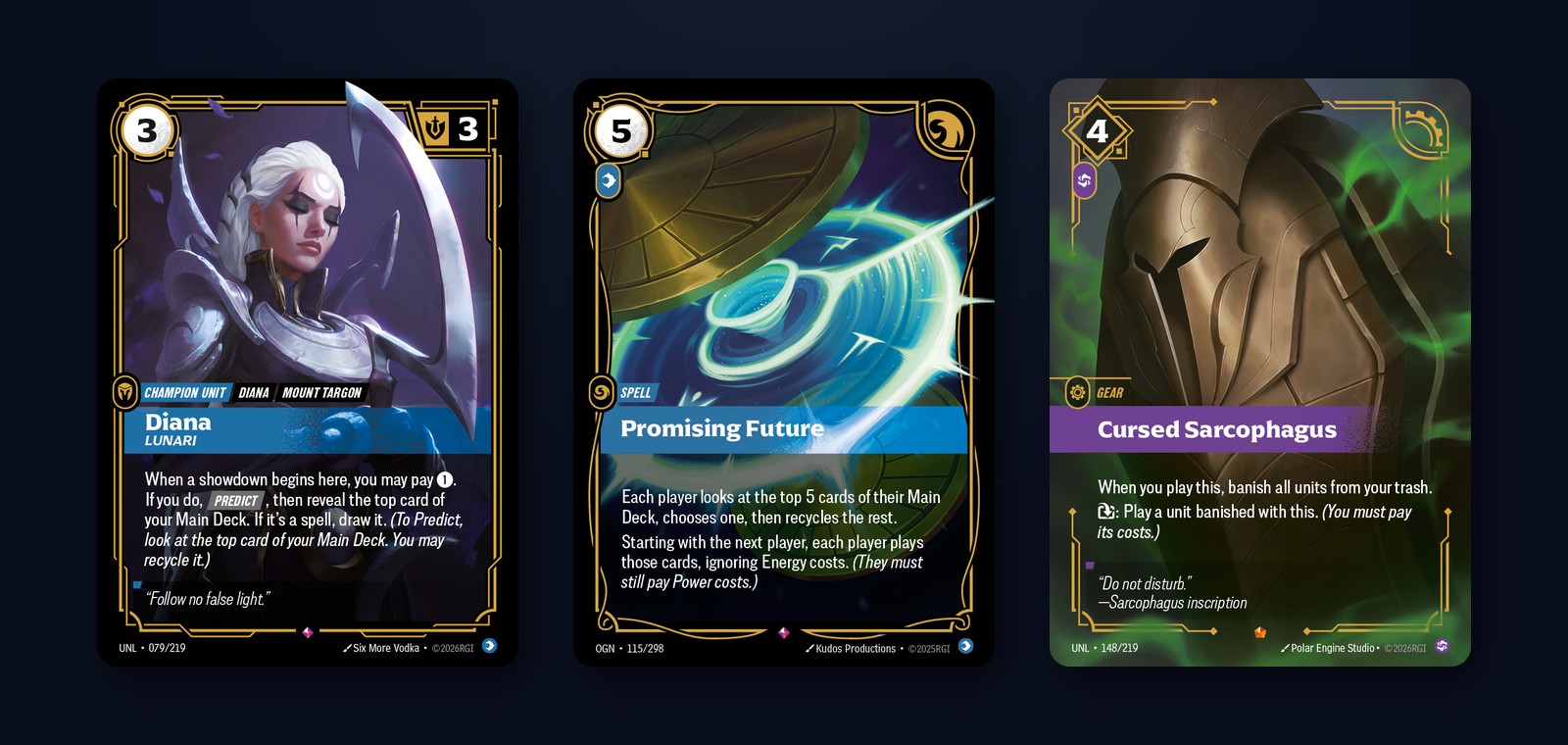
2. Paying Energy and Power is always optional. There was a curious asymmetry: if an effect instructed you to pay a resource you already had in your rune pool, you had to pay it; if you didn't have it, nothing could force you to generate it. The two cases are now unified: with cards like Diana, Lunari, Promising Future or Cursed Sarcophagus you can always choose not to pay (and the instruction is ignored). This only applies to Energy and Power: every other cost remains mandatory if you're able to pay it.
3. Tokens stay tokens, forever. «Token» is no longer a supertype but an intrinsic category of the game object, just like «card». However a token gets copied, altered or manipulated, it can't lose its token nature — and a card can never become a token. This closes a family of problematic interactions with copy effects.
And then there's the announcement's most interesting competitive signal: the rules for battlefield reuse in Best-of-5. In games 4 and 5 players may present a battlefield already removed from the game (only after presenting all of theirs at least once, and at most two presentations per battlefield). Translation: Riot is preparing best-of-5 top cuts for high-level events. Together with the 2v2 clarifications — points shared by the team and teammates' battlefields not scorable during your own scoring step — and the dedicated 2v2 ban list, the picture is clear: the team format is becoming a fully-fledged competitive format.
| Area | What changes |
|---|---|
| «Ghost» Contested | During cleanup, Contested status is removed from battlefields with no units from the player who applied it (no more «Flash in response to a move trigger» limbo) |
| «When I die» | Every death trigger (not just Deathknell) uses information from when its source was on the board |
| Delayed abilities | If the duration already ended before the ability would be generated, it isn't generated at all |
| Split damage | If at resolution there are more targets than damage available, the effect's controller decides which targets drop (and can't keep fewer targets than damage to split) |
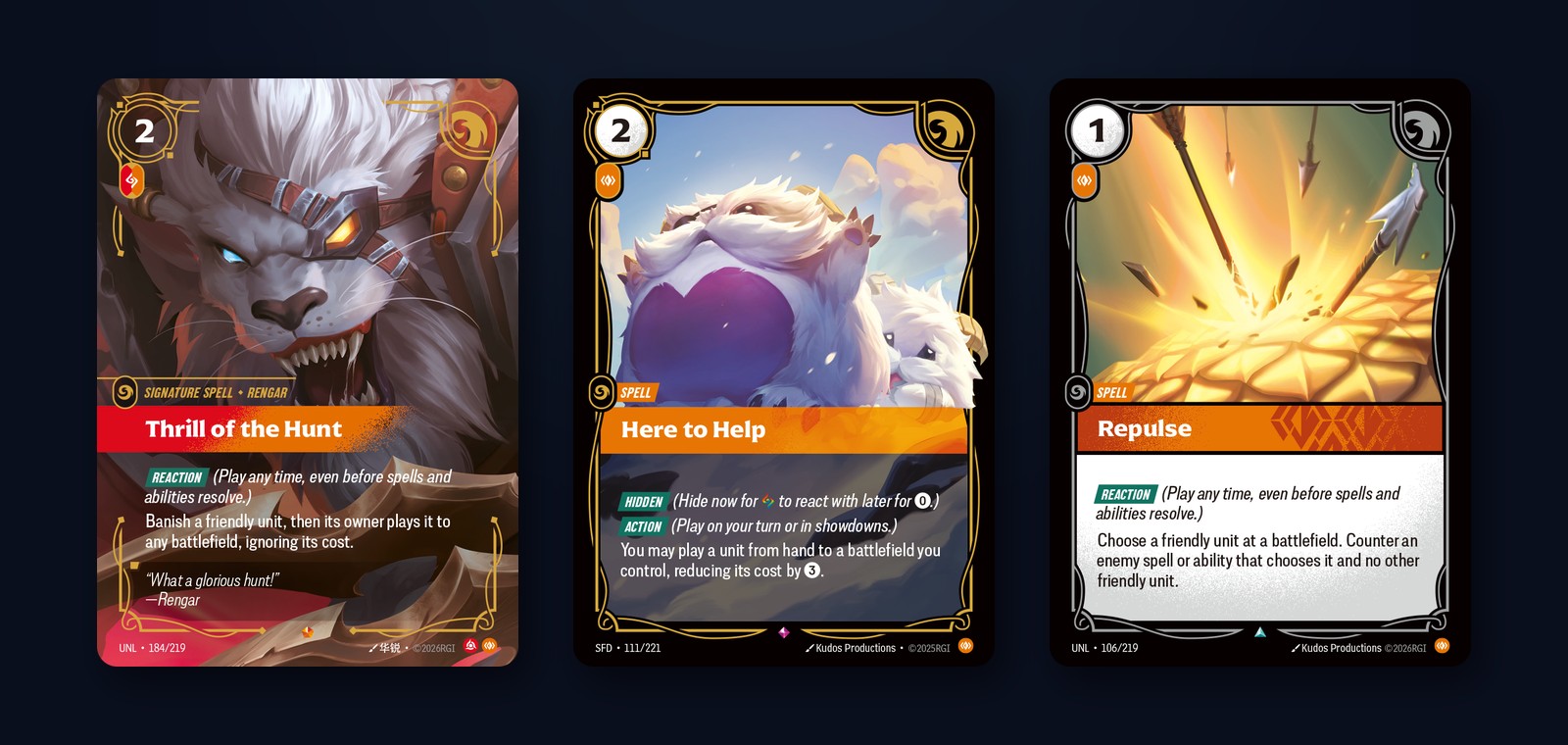
| Targeting | Zones or objects mentioned only as a restriction/permission for an action are NOT targets (Thrill of the Hunt, Here to Help) |
| Hidden | The targeting restriction on hidden spells applies to each choice separately and individually |
| «You may» triggers | The choice is made at finalization, not when the ability triggers (relevant for «once each turn» abilities) |
| The three «play»s | The three meanings are codified: as a game action (put on the chain), in triggers (=resolved), everywhere else (=finalized) |
| Lethal damage & «your damage» | Unified definition across the document; «your damage» = the damage you marked |
| Battlefield abilities | Whoever makes the choice for a battlefield ability is its controller, regardless of who controls the battlefield |
| Counting targets | Counts (as with Repulse) include mistargeted choices, but not targets that left the board |
| «Activate» and Accelerate | «Activating» a named triggered ability is defined; Accelerate = optional additional cost + delayed replacement (the unit still enters ready even if it loses the keyword, as long as the cost was paid) |
From the tournament changelogSideboards go to 10 cards (and the other Tournament Rules news)
Also today, and also effective July 24, Riot updated the Tournament Rules. The change that touches everyone: the sideboard grows from 8 to 10 cards. The reasoning is metagame variety — more cards and more Champions around mean more matchups to prepare for — and Vendetta, which brings several designs aimed squarely at the sideboard, is the perfect occasion. Two extra slots may sound small, but for a careful builder they're a whole extra plan B: keep it in mind when you update your decks in the Deck Builder.
The changelog's other news, in short:
- 🗣️ «Acknowledge» = communicate: acknowledging a trigger or a change to public information now explicitly requires communicating it to the other players at the table.
- 🧮 Tracking resources: new guidelines on when and how to track XP and floating Energy/Power, not just the score.
- ⚖️ Questions to judges: clarified what a floor judge can answer — rules, card text and policy yes, strategy no. The word «hypothetical», which created more confusion than clarity, is gone.
- 📜 Disciplinary Code: a new section expanding the Unsporting Conduct values and aligning Riftbound with Riot's other games. In practice, nothing changes for players.
- ✅ Vendetta is officially legal in sanctioned Standard from the effective date.
Our readingWhat this update tells us
Three things, looking past the rulebook. First: Riot is listening. Shipping the patch notes earlier than with Unleashed is a direct answer to the complaints about timing, and the sheer amount of formal definitions (events, applied costs, replacements) says the rules team is steering Riftbound towards mature-TCG rigor. Not by chance, a major re-templating of card wording has already been announced to finally untangle the historical ambiguity of «play».
Second: the trash is the new frontier. Flow and Burn together push towards archetypes that play from the graveyard, and the dedicated symbol on cards is an explicit promise that this direction will continue in future sets. When you update your decks in the Deck Builder, start thinking of your trash as a resource.
Third: on July 24 the meta truly resets. Bans on Stealthy Pursuer and the two battlefields, new rules, sideboards widened to 10 cards: it's the biggest reset since Unleashed launched. We'll be watching how the tier list settles over Vendetta's first weeks.
In short
- 🆕 Vendetta brings 4 mechanics: Empower/Empowered (lasting status), Flow (spells from the trash, then banished), Burn (cards from deck to trash) and Skip.
- 📅 The new Core Rules take effect on July 24, 2026, the same day as the bans — announced early to give time before the Pre-Rift events.
- ⚠️ The power cost of dual-domain cards (like the Signature Spells) is now formally tied to the card's domains — zero practical impact today (your deck already produces only those colors), but the rule is ready for any future multi-domain cards.
- 💰 Paying Energy and Power is always optional; tokens can no longer lose (nor cards acquire) their token nature.
- 🏆 Rules for Best-of-5 arrive (battlefield reuse in games 4-5) along with 2v2 clarifications: the competitive circuit is taking shape.
- 📋 From the Tournament Rules update: the sideboard grows from 8 to 10 cards and Vendetta becomes Standard-legal.
Frequently asked questionsFAQ: Vendetta's rules
When do the new rules take effect?
On July 24, 2026, the same day as the July bans. Riot published them a week early to give judges and players time to read them before Vendetta's Pre-Rift events.
What exactly does Empower do?
It's an activated ability with a cost: pay it and the card becomes «empowered», a status that lasts as long as it stays on the board or until something disempowers it. On its own it does nothing, but it switches on the Empowered effects on the same card.
How does Flow work?
It's an alternate cost that appears on spells: by paying it you can play the spell directly from your trash; after resolving, it gets banished. Flow cards have a dedicated symbol in their text box.
Do the new rules change cards from previous sets too?
Yes. The power cost of dual-domain cards (like the Legends' Signature Spells) is now formally tied to the card's domains (no practical impact: your deck already produces only those colors); paying Energy and Power becomes always optional; tokens can no longer change nature; and every «When I die» trigger uses information from before the death.
Is the sideboard really growing to 10 cards?
Yes: the Tournament Rules update published the same day raises the Constructed sideboard limit from 8 to 10 cards, also effective July 24, 2026. In the same changelog: Vendetta becomes Standard-legal, new guidelines for tracking XP and floating resources, and the new Disciplinary Code.
Where can I read the full Core Rules document?
On the official Riftbound Rules Hub, which hosts the always up-to-date Core Rules, Tournament Rules, patch notes and errata.
Source: Core Rules: Vendetta Patch Notes and July 2026 Tournament Rules Update & Changelog on playriftbound.com; full document on the Rules Hub. Summary and analysis by the Riftbound Zone editorial team. Key art © Riot Games.
Spotted an error?
To send a report you must first log in or sign up: it only takes a few seconds.